

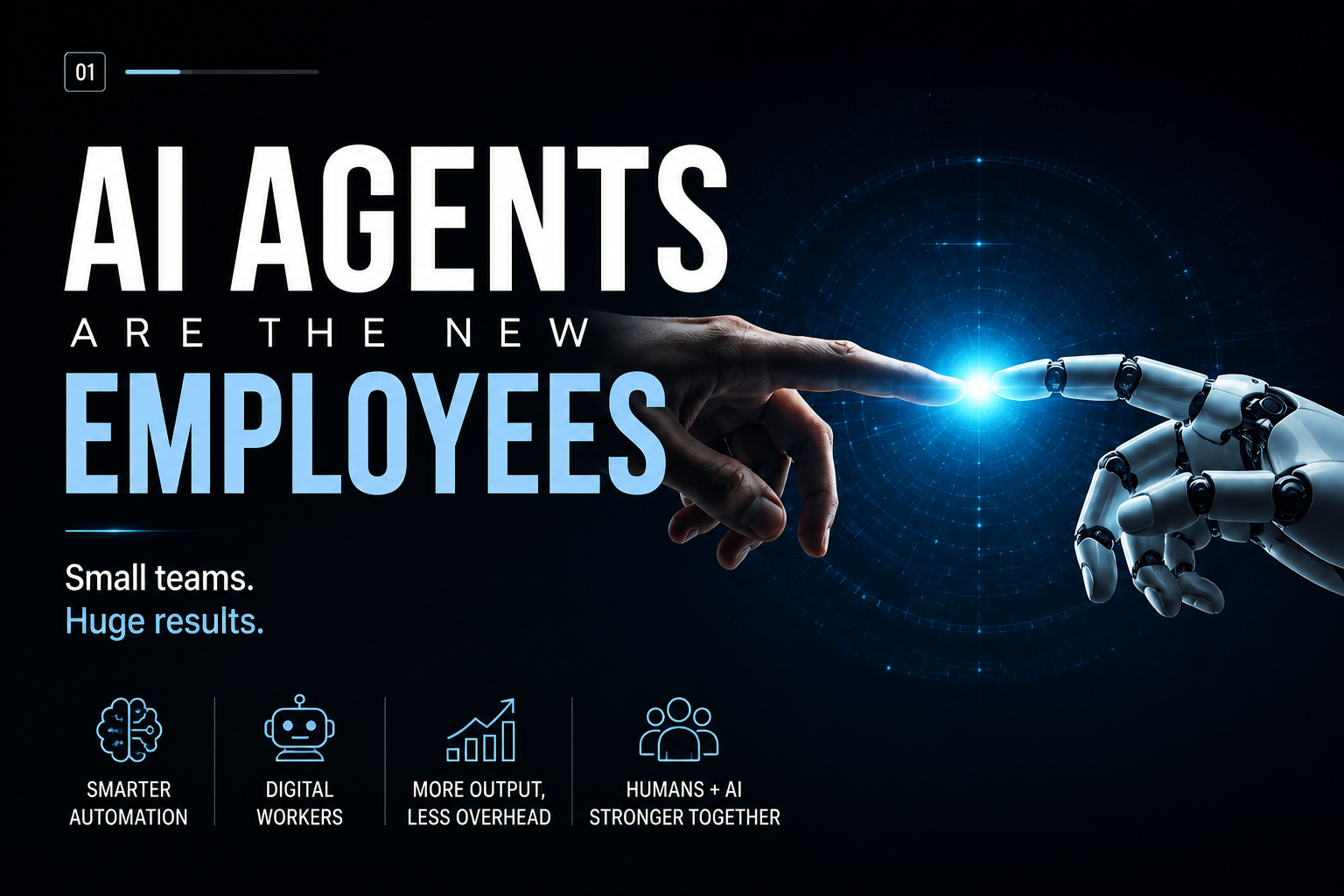

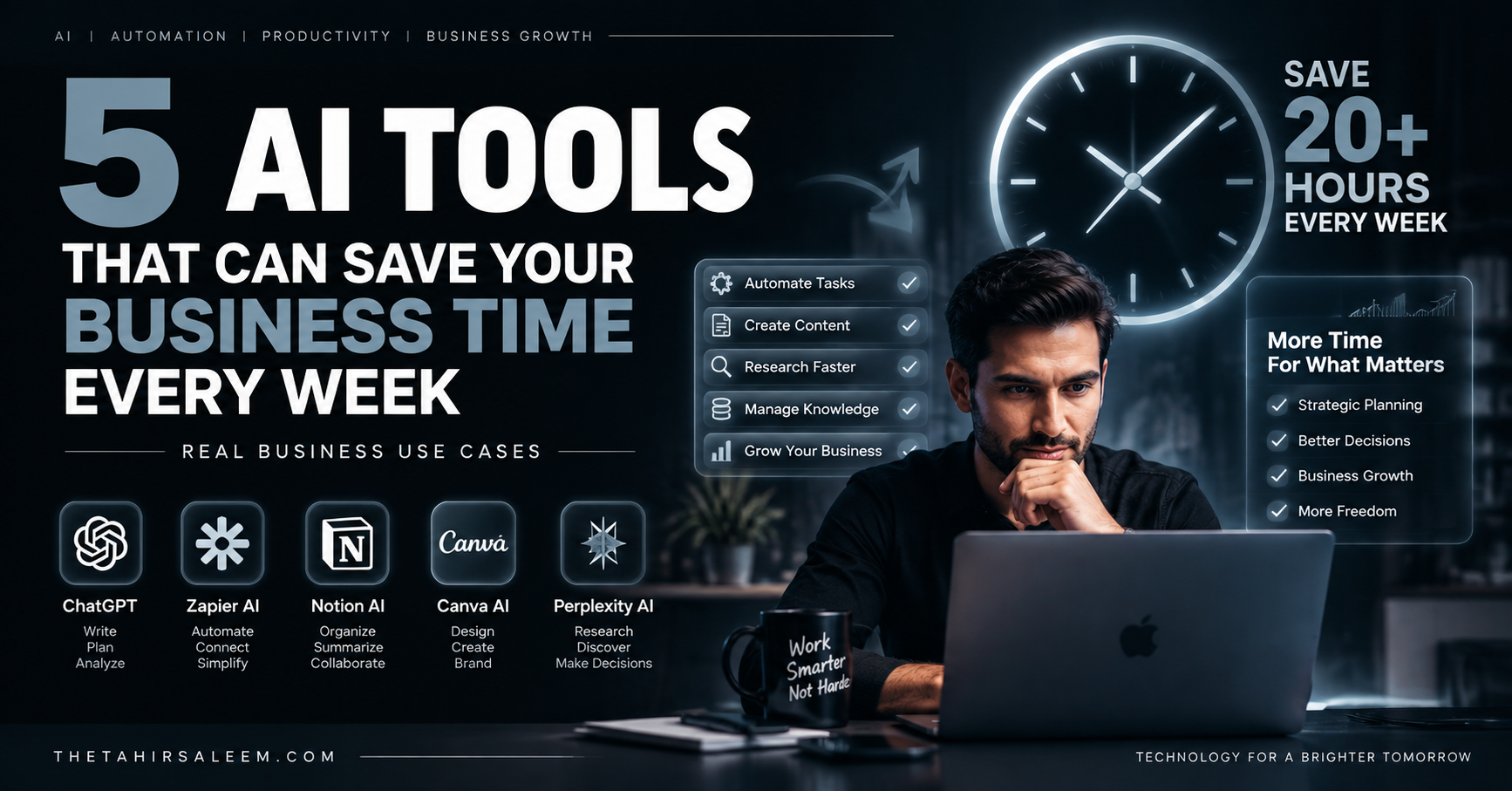





Introduction: The Era of AI Employees Has Already Started
“The biggest companies of the future may not be the ones with the most employees. They may be the ones with the smartest AI workforce.”
A few years ago, if someone told me that a small business owner could have a team of digital workers helping with sales, marketing, customer service, research, and operations, I probably would have thought it sounded like science fiction.
But today, that future is becoming reality.
The way businesses operate is changing faster than most people realize. We are moving from a world where companies hire humans to complete tasks, into a world where humans manage intelligent AI agents that can complete entire workflows.
And this shift is much bigger than just another technology trend.
The internet changed how businesses communicate. Smartphones changed how customers interact with brands. Cloud computing changed how companies store and manage information.
Now AI agents are changing something even deeper:
How businesses work.
When I first started exploring AI tools, I made the same mistake many people make. I thought AI was mainly about asking questions, generating text, or creating images faster.
That was only the beginning.
The real breakthrough happened when I understood the difference between a simple AI assistant and an AI agent.
A chatbot gives you an answer.
An AI agent takes a goal and works toward completing it.
That difference is enormous.
Imagine telling an employee:
“Research my competitors, analyze their marketing strategy, find opportunities, create a report, and suggest my next actions.”
A traditional software tool cannot do that alone.
But an AI agent can break the goal into smaller steps, use different tools, analyze information, and return with meaningful results.
This is why many business leaders are starting to view AI agents differently.
They are not just software.
They are becoming digital employees.
What Are AI Agents? Understanding The New Digital Workforce
When people hear the term “AI agent,” they often imagine a more advanced chatbot.
That understanding is incomplete.
An AI agent is an artificial intelligence system designed to perform tasks autonomously by understanding objectives, making decisions, using tools, and completing workflows with limited human involvement.
A simple AI chatbot works like this:
Human asks → AI answers
An AI agent works differently:
Human gives goal → AI plans → AI takes actions → AI completes task → Human reviews results
This is the biggest change.
For example, a customer support chatbot may answer:
“Your order is currently being processed.”
But a customer support AI agent could:
- Check the customer’s order history
- Identify the issue
- Search company policies
- Offer possible solutions
- Create a support ticket
- Escalate the problem if necessary
- Follow up later
It behaves much more like an employee.
When I first tested AI automation workflows, one thing became very clear: the value was not in asking AI to create small pieces of content.
The real value was connecting AI with business systems.
An AI agent connected to:
- CRM software
- Email platforms
- Analytics tools
- Databases
- Project management systems
can become a powerful digital team member.
This is where businesses are starting to rethink their entire structure.
Why AI Agents Are Becoming The New Employees
Every business has one common challenge:
How do we achieve more with fewer resources?
For decades, companies solved this by hiring more people.
More customers meant more sales employees.
More support requests meant more customer service representatives.
More projects meant more managers and teams.
But AI agents introduce a completely different approach.
Instead of only increasing the number of employees, businesses can increase their digital workforce.
A company could create specialized AI employees for different roles.
The AI Marketing Employee
A marketing AI agent can help with:
- Market research
- Content planning
- SEO analysis
- Social media ideas
- Competitor research
- Campaign optimization
Instead of spending hours collecting information manually, marketers can focus on strategy and creativity.
The AI Sales Employee
Sales teams spend a huge amount of time on repetitive activities.
An AI sales agent can:
- Research potential customers
- Analyze leads
- Personalize outreach messages
- Schedule meetings
- Track customer interactions
- Update CRM records
This allows human sales professionals to spend more time building relationships.
The AI Operations Employee
Many business tasks are necessary but repetitive.
An operations AI agent can:
- Organize documents
- Create reports
- Monitor workflows
- Analyze performance data
- Identify problems
These tasks previously required hours of human effort.
The important point is this:
AI agents are not simply replacing individual tools.
They are combining the abilities of many tools into intelligent systems that can complete meaningful business processes.
That is why this shift is being compared to some of the biggest technological transformations in history.
The difference is that AI agents are not just tools.
They can actively participate in completing work.
Why Small Businesses May Benefit The Most From AI Agents
Large companies have always had advantages:
- Bigger budgets
- More employees
- Larger departments
- More resources
But AI agents may reduce this gap.
A small business that adopts AI effectively can now access capabilities that were previously expensive.
For example:
A small online store may not afford a full marketing department.
But with AI agents, it can have support with:
- Product research
- Customer communication
- Email campaigns
- Advertising analysis
- Content creation
A small consulting business may not have a research team.
But AI agents can help analyze:
- Industry reports
- Competitor strategies
- Market opportunities
A startup may not have a large development team.
But AI coding agents can assist developers with:
- Writing code
- Testing applications
- Finding errors
- Documentation
This does not mean every small business will automatically succeed.
AI is not magic.
A poorly designed business with AI will still fail.
But a smart business using AI effectively can move much faster.
AI Agents vs Human Employees: The Real Comparison
Many conversations about AI focus on one question:
“Will AI replace humans?”
But this question is too simple.
The more important question is:
“Which tasks will AI handle, and which tasks will remain uniquely human?”
AI agents are extremely powerful at:
- Processing information
- Finding patterns
- Performing repetitive tasks
- Working continuously
- Managing large amounts of data
Humans remain stronger at:
- Emotional intelligence
- Creativity
- Leadership
- Trust building
- Complex judgment
- Understanding human behavior
The future workplace will likely not be humans versus AI.
It will be:
Humans + AI agents working together.
A great employee with AI tools may outperform an employee without them.
A great company using AI systems may outperform a company ignoring them.
The competitive advantage will not simply come from having AI.
It will come from knowing how to use AI strategically.
The New Job Role: AI Workforce Manager
A new type of professional role is emerging:
The AI Workforce Manager.
In the future, managers may not only manage human employees.
They may manage teams that include both humans and AI agents.
Their responsibilities could include:
- Creating AI workflows
- Assigning tasks to AI agents
- Reviewing AI performance
- Improving automation systems
- Ensuring quality and accuracy
This creates a major opportunity for people who learn AI skills early.
The valuable employee of the future may not be the person who avoids AI.
It may be the person who understands how to direct it.
How Businesses Can Start Building Their AI Workforce
Many business owners make the mistake of waiting for AI technology to become “perfect.”
But technology rarely becomes perfect before adoption.
The companies that win usually experiment early.
A practical approach is:
Step 1: Identify Repetitive Tasks
Look at daily operations.
Ask:
- What tasks consume the most employee time?
- What processes happen repeatedly?
- What information needs regular analysis?
These are excellent places to introduce AI agents.
Step 2: Start With One AI Employee
Do not try to automate everything immediately.
Choose one area.
Examples:
- Customer support AI agent
- Marketing research AI agent
- Sales assistant AI agent
Measure the results.
Improve the workflow.
Then expand.
Step 3: Train Your Team To Work With AI
The biggest mistake is treating AI as a replacement strategy.
The better approach is an enhancement strategy.
Teach employees:
- How to communicate with AI
- How to review AI outputs
- How to create better workflows
- How to combine human creativity with AI efficiency
The companies that succeed will not simply have AI.
They will have people who know how to work with AI.
How AI Agents Will Transform Every Industry
When people talk about AI agents, they often imagine technology companies and software developers.
But the truth is much bigger.
AI agents will not belong to only one industry.
They will become part of almost every business sector because every industry has something in common:
They all have repetitive processes, information overload, and decisions that require better systems.
The companies that understand this early will have a significant advantage.
Let’s look at how AI agents are changing different industries.
Healthcare: AI Agents As Digital Medical Assistants
Healthcare is one of the industries where AI agents can create enormous improvements.
Doctors and healthcare workers spend a lot of time on administrative tasks:
- Managing appointments
- Organizing patient information
- Preparing reports
- Reviewing medical research
- Handling documentation
AI agents can support these workflows.
For example, a healthcare AI agent could:
- Organize patient records
- Summarize medical information
- Help doctors find relevant research
- Assist with scheduling
- Improve communication between departments
The goal is not replacing doctors.
A machine cannot replace human empathy, experience, and medical judgment.
The goal is allowing healthcare professionals to spend more time doing what humans do best:
Taking care of people.
Finance: AI Agents For Smarter Decisions
The financial industry has always been driven by data.
Banks, investment companies, and financial businesses analyze huge amounts of information every day.
AI agents can help with:
- Market analysis
- Fraud detection
- Risk assessment
- Customer support
- Financial reporting
Imagine a financial analyst having an AI research assistant that works 24 hours a day.
The AI agent can monitor market changes, analyze reports, and highlight important information.
The human expert still makes the final decisions.
But instead of spending hours collecting information, they can focus on strategy.
Education: Personalized AI Teachers
Education is another area where AI agents can create a major shift.
Traditional education usually follows one approach:
One teacher.
Many students.
One learning speed.
But every student learns differently.
AI education agents can create personalized learning experiences.
They can:
- Explain difficult concepts differently
- Provide practice exercises
- Answer questions instantly
- Track learning progress
- Suggest improvements
A student struggling with mathematics could have an AI tutor available anytime.
A professional learning a new skill could have a personal AI coach.
The future of education may become much more personalized.
Marketing: The Rise of AI Marketing Teams
Marketing may be one of the first areas where businesses adopt AI agents at scale.
Why?
Because marketing involves many repetitive information-based tasks.
A marketing team today spends time on:
- Research
- Content planning
- Competitor analysis
- Data reporting
- Customer segmentation
AI agents can support all of these areas.
An AI marketing employee could:
- Monitor trends
- Analyze audience behavior
- Suggest content ideas
- Create campaign drafts
- Review performance data
But there is something important to understand:
Great marketing is not only about producing more content.
It is about understanding people.
Human creativity, storytelling, and emotional connection will remain extremely valuable.
AI can increase the speed.
Humans provide the vision.
Software Development: AI Coding Employees
Software development is experiencing one of the fastest AI transformations.
Developers are now working with AI coding assistants and autonomous coding agents that can help with:
- Writing code
- Finding bugs
- Testing applications
- Creating documentation
- Understanding large codebases
A developer with AI assistance can often complete tasks much faster.
But the role of developers is changing.
The future developer may spend less time writing every line manually and more time:
- Designing systems
- Solving complex problems
- Reviewing AI-generated solutions
- Making strategic technical decisions
Programming is moving from simply writing code to managing intelligent systems.
Common Mistakes Businesses Make With AI Agents
While AI agents create incredible opportunities, many companies approach them incorrectly.
Technology alone does not create success.
The strategy behind the technology matters.
Here are some common mistakes businesses should avoid.
Mistake 1: Treating AI Like A Simple Tool
Many companies use AI only for small tasks.
They ask:
“Can AI write this email?”
“Can AI create this image?”
“Can AI summarize this document?”
These are useful, but they represent only a small percentage of AI’s potential.
The bigger question should be:
“What business process can AI improve completely?”
Instead of using AI for individual tasks, businesses should design complete AI-powered workflows.
Mistake 2: Automating Broken Processes
A common mistake is automating a bad system.
For example:
A company has a confusing customer support process.
Instead of improving the process, they add an AI agent on top.
The result?
A faster confusing system.
Before implementing AI, businesses should understand:
- What is the current workflow?
- Where are the bottlenecks?
- What information does AI need?
- Where does human involvement remain necessary?
Good automation starts with good processes.
Mistake 3: Ignoring Human Oversight
AI agents are powerful, but they are not perfect.
They can:
- Misinterpret information
- Make incorrect assumptions
- Generate inaccurate results
Businesses should create systems where humans review important decisions.
The future is not:
“AI does everything.”
The future is:
“AI handles what it does best, humans handle what they do best.”
Mistake 4: Waiting Too Long
One of the biggest mistakes companies can make is ignoring AI completely.
Many businesses waited years before adopting websites.
Many ignored social media until competitors gained an advantage.
The same pattern may happen with AI agents.
Early adopters will learn faster.
They will build better systems.
They will understand what works.
Companies that wait may eventually have to catch up.
The Future Of Work: Humans Managing Teams Of AI Agents
The workplace of the future may look very different.
A manager may not only lead a team of human employees.
They may manage:
- Five human employees
- Ten AI agents
- Multiple automated workflows
The traditional organizational chart may change.
Instead of departments filled only with people, companies may have:
Human + AI departments.
For example:
A marketing department could include:
- Marketing Director
- Creative Strategist
- AI Research Agent
- AI Content Agent
- AI Analytics Agent
A sales department could include:
- Sales Manager
- Human Sales Representatives
- AI Lead Generation Agent
- AI Customer Research Agent
This creates a new business model.
Companies will no longer measure only employee numbers.
They will measure intelligence capacity.
The Skills Humans Need In The AI Agent Era
As AI becomes more capable, human skills become even more important.
The most valuable skills will include:
Strategic Thinking
Knowing what problems to solve.
Creativity
Creating ideas that connect with people.
Communication
Building relationships and trust.
Leadership
Managing humans and AI systems together.
AI Literacy
Understanding how to use AI effectively.
The future belongs to people who learn how to collaborate with intelligent machines.
Final Thoughts: The AI Workforce Revolution Has Begun
AI agents are not just another technology improvement.
They represent a fundamental change in how businesses operate.
For more than 100 years, companies grew by hiring more people.
The next generation of companies may grow by building smarter systems.
The question is no longer:
“Will my business use AI?”
The question is:
“How will my business use AI better than competitors?”
AI agents are becoming the new employees.
The businesses that learn to combine human creativity with AI capability will define the next era of innovation.
The future workplace is not humans versus machines.
It is humans working with machines to achieve things that were previously impossible.
The AI workforce revolution has already started.
The only question is:
Are you ready to build your AI-powered company?